
Home
Knowledge Center
Hand-knotted or Machine Made Oriental Rugs
Rugs are not all the same! Learn how a hand-knotted rug is constructed – and how to recognize the imitations: hand-tufted and machine-made rugs.
Oriental rugs have long been considered the ‘royalty of rugs’. In ancient times wool and silk area rugs were crafted for royal families who ruled the regions of Asia, China, Iran, Turkey and other Persian territories.
Today, these decorative items have become more than just a floor embellishment. Many are passed down for generations and become heirlooms. Others are investment pieces purchased for their beauty, some are prayer rugs and others are just the perfect complement to a room in our house.
Handmade rugs are religiously woven and crafted using fine wool and silk by artisans using skills that have been passed down for generations. A typical handmade 8X10 hand-knotted wool rug can take 18 months or longer to make, so these rugs are naturally more expensive than those manufactured by a machine.
Hand-knotted
Typical characteristics:
- The pattern is almost as clear on the back as the front side of the rug.
- The depth, clarity, and density of the design are unmatched by any other rug type.
- The fringe is part of the rug and not sewn on to the rug.
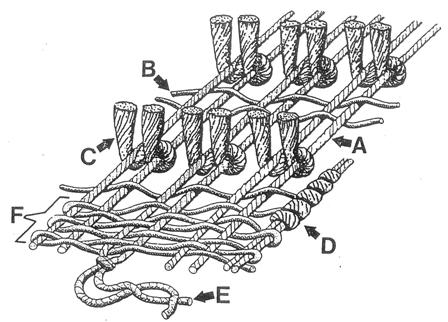
- A – Warp: the foundation of the rug. Parallel threads running through the entire length of the rug, on which knots are tied.
- B – Weft: the strength element. Threads woven across the width of the rug between all the rows of knots, passing through alternate warp threads.
- C – Knot: the main part of the rug. A strand of wool or silk looped around two adjacent warps and then cut to form the surface.
- D – Overcasting: also called the binding. Yarn wrapped along both sides of the rug to help keep the knots secure.
- E – Fringe: the visible continuation of the warp threads at both ends. The length of fringe does not signify quality.
- F – Kilim: the woven web of warp and weft at both ends, between the pile and the knotted fringe.
Hand-Tufted
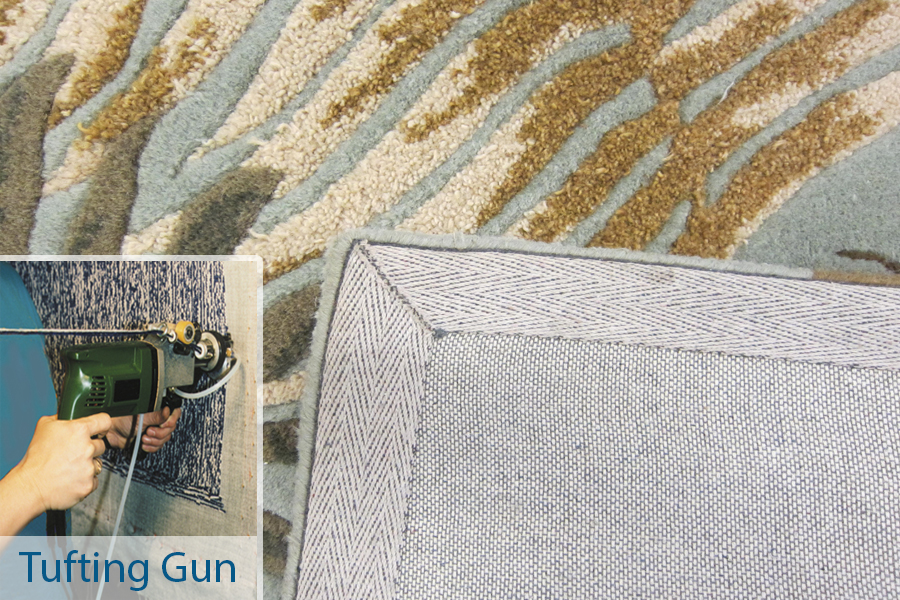
The word “hand” in “hand-tufted” gives a false illusion that the rug is handmade. A tufting machine inserts the yarn into a grid-work backing, glue or latex is applied to the back to hold the fibers in place, and a fabric is applied over the glue for a neater appearance. The fibers used are lower grade, and this type of rug does not clean as well as others. The glue can become dry and brittle over time, and significant shedding and a burned rubber smell are common. A machine made rug is a much better alternative for about the same price.
Machine Made
Machine made rugs are produced by an electronically powered machine, with the pattern usually illustrated by computer or a punch card system. Qualities vary widely. Avoid synthetic fibers and heat-set or power-loomed construction; rugs made on Axminster and Wilton looms are the best ones to choose, and wool machine made rugs manufactured in Belgium are considered among the best in this category.
Can you spot the difference between a hand-knotted and a machine made Oriental rug?
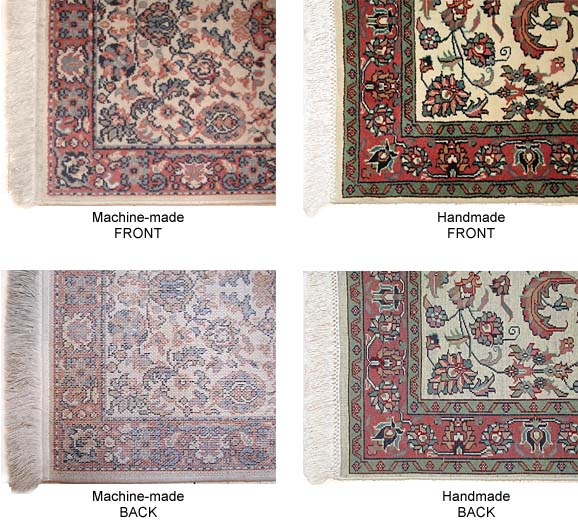
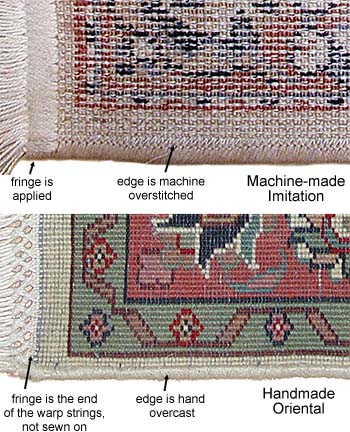
Note the strong visual differences, especially on the back. The design is not nearly as colorful on the back of the machine-made rug as on the face. There is an overstitch pattern across the whole back; you cannot distinguish individual knots because there aren’t any. The fringe is stitched on after the rug is complete, whereas the fringe of a handmade rug is made up of the warp strings coming out of its ends.
What Difference Does It Make?
The biggest complaint in the industry is the ongoing effort by machine-made manufacturers and retailers to blur the difference between their product and genuine hand-knotted rugs. We’ve seen manufacturers affix a sticker claiming a rug is “handmade” when it is in fact “hand-tufted” – and the difference in price can be several thousand dollars.
Furniture stores, carpeting dealers, auction and estate dealers and some large home improvement stores sell a changing mix of machine-made and hand-made rugs which they often lump together as “Oriental rugs”. Many consumers have overpaid thinking they have a real hand-knotted Oriental rug when in fact they have an inexpensive tufted area rug.
For most dealers in genuine Oriental rugs, an “Oriental rug” is a piled or flatwoven fabric hand-knotted in one of the traditional weaving areas of the Middle or Far East: Afghanistan, China, India, Iran, Nepal, Pakistan, Tibet, Turkey, some southern territories of the old Soviet Union (like Azerbaijan or Armenia), Balkan countries like Romania and Albania, and some North African countries like Morocco and Egypt.
Genuine Oriental rugs are not made in Belgium or anywhere else in Western Europe or in the United States (hand-woven rugs made by Native Americans in the American Southwest are called “Navajo rugs” or “American Indian rugs”). Wilton®, Karastan®, and Couristan® rugs are machine-made rugs in Oriental designs; they are not “Oriental rugs”. No genuine Oriental rugs are made of nylon or polypropylene.
Ready to give your rug the care it deserves?
Tell us about your rugs and we’ll get back to you with a quote. Free local pick-up and delivery for most rugs.